Described as a European-style market, anchored by a wine bar, this could add an exciting dynamic to Scranton’s culinary scene…
Scranton knows the difference between an idea and a place.
An idea lives in renderings and hopeful language. A place has footsteps. It has regulars. It has the particular kind of noise that happens when people decide, quietly, instinctively, that this is where they want to be on a Saturday morning, or after work, or on a gray afternoon when staying home feels like giving up.
That’s why Lace Village’s newest announcement has the feel of something worth paying attention to.
Lace Village has revealed its next major addition: Market at Lace, described as a two-part marketplace planned within the Lace Village campus in Scranton. It’s early, more outline than blueprint, but the intent is clear. A prepared-food hall with a full wine bar. A year-round shopping market for local products. Two spaces meant not just for convenience, but for lingering.
And Lace Village isn’t being shy about the scale of what it wants this to become. The project language name-checks major destination-style markets like Reading Terminal Market and Eataly, big, bold comparisons that signal this isn’t being framed as a simple amenity for the people who live on campus. It’s being framed as something larger: a place people might choose to visit.
Whether Scranton actually gets that kind of experience will come down to the details that make or break every market worth loving, vendors, flow, hours, pricing, and most importantly, whether the space has the kind of energy that draws people back before they’ve even realized it’s become a habit.
Still, even at this early stage, the announcement raises an interesting, and very Scranton, question: what happens when a redeveloped historic campus begins building a permanent, curated home for local food and drink businesses?
What Lace Village says Market at Lace will be…
According to Lace Village’s project description, Market at Lace will be divided into two distinct zones, one focused on prepared food, one on retail.
The first is the prepared-food side: multiple local businesses serving freshly made food, paired with a full wine bar, and seating designed to keep people on site. Not a hallway of grab-and-go counters, but something closer to an experience, something with intention. The difference matters. Scranton has no shortage of places to eat. What it has less of is a space built to encourage lingering, where ordering something turns into staying, and staying turns into returning.
The second zone is retail-forward: a shopping marketplace where visitors can buy local products year-round. In the way it’s described, it reads less like an occasional vendor fair and more like a permanent, indoor market, something that isn’t dependent on weather, season, or weekend-only momentum. That kind of consistency can matter tremendously for small-batch producers and specialty makers who have strong product and strong followings, but not necessarily the time, appetite, or resources for a standalone storefront.
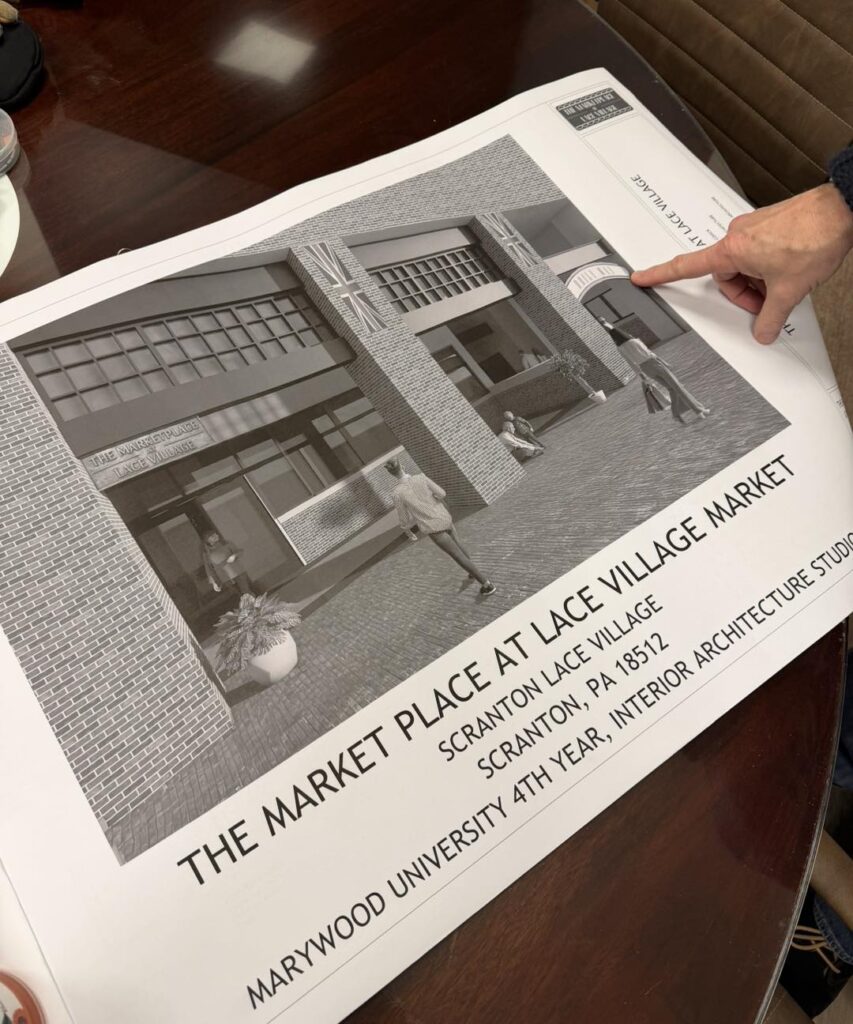
Another notable detail: Lace Village has confirmed that it’s collaborating with Marywood University interior architecture students, and a publicly shared rendering board supports that involvement. Even from the limited preview, the design work suggests they’re thinking about how the market will feel, not just what it will contain. Entry flow. Branding. The way the spaces connect to the campus itself. Those choices are often what determine whether a market becomes a destination or just a nice idea.
Why Lace Village is a meaningful setting for this project…
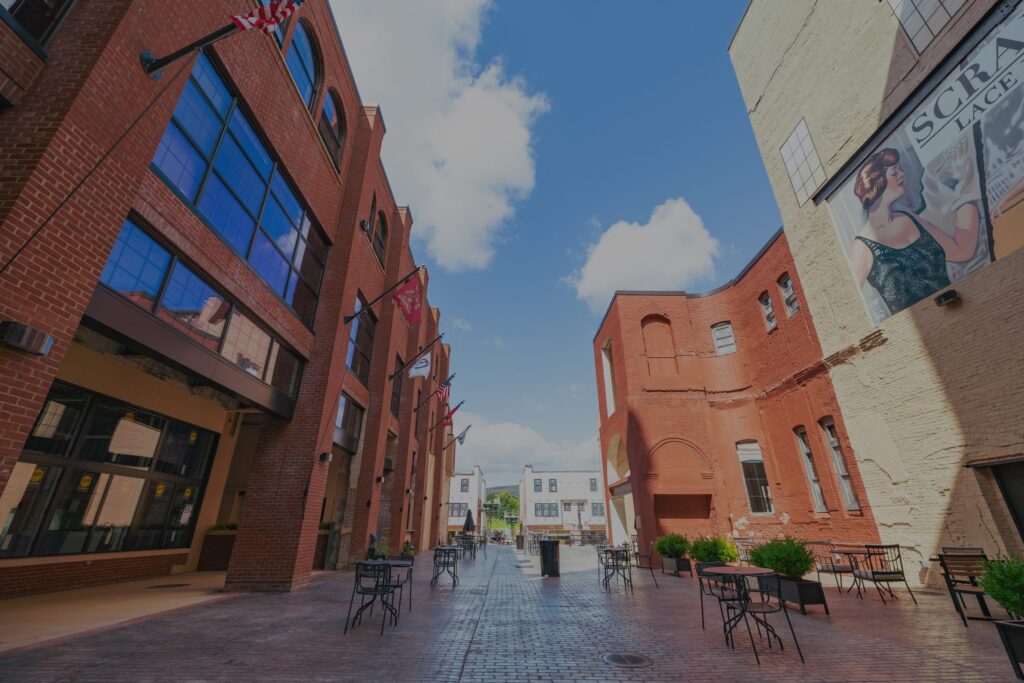
Markets are made of people, but they’re also made of place. Atmosphere. History. The feeling of stepping into a space that doesn’t feel interchangeable.
And Lace Village, for all its newness, has weight.
The campus is a redevelopment of the former Scranton Lace Company complex, a historic industrial site with deep roots in the city. Lace Village’s own “About” history outlines the arc: Scranton Lace Company was founded in 1890, grew into the largest manufacturer of Nottingham lace in the world, and at its peak employed more than 1,600 workers. During World War II, it produced Victory parachutes, one of those details that stops you for a moment and reminds you that Northeastern Pennsylvania’s industrial story isn’t abstract. It’s personal. It’s stitched into families.
Then came decline. Bankruptcy. The factory’s closure in 2002. The familiar Rust Belt ache of something massive falling quiet and staying that way long enough that people begin to stop believing it will ever come back.
Lace Village’s redevelopment has steadily pushed against that resignation. Multiple buildings restored. Historic elements highlighted, the Clock Tower, and the enormous Nottingham loom. And even now, the campus still holds space that’s waiting for its next purpose.
So if Market at Lace happens, it won’t be dropped into a sterile shell. It will live inside a place that already carries memory. That matters, especially for food-and-drink spaces, where atmosphere is never just decoration. It’s part of the flavor.
What it could mean for the local food + drink ecosystem…
The comparisons to big-city markets are flashy, but the more interesting part of this announcement is structural.
A permanent multi-vendor market creates something many local operators struggle to access: a ladder. A way to grow without making a terrifying leap.
In the best food-hall and market models, you don’t just get “new places to eat.” You get a pathway that looks like this:
pop-up → vendor stall → steady following → confidence → brick-and-mortar
That matters in a region where talent is not the issue. The product is not the issue. The problem, more often, is that the capital and risk tolerance required for a full traditional restaurant lease can feel like a cliff.
If Market at Lace recruits the right mix, it could become meaningful for chefs, bakers, and specialty makers who have proven appeal but aren’t ready to mortgage everything on a permanent standalone spot. It could become a staging ground. A testing kitchen. A public-facing incubator that doesn’t demand you gamble your entire life.
The wine bar adds another layer of possibility, not because wine is rare in Scranton (it certainly isn’t), but because a dedicated wine bar has the potential to become the heartbeat of programming. Tastings. Pairing events. Vendor collaborations. Seasonal spotlights. Reasons to come back that don’t rely on novelty or buzz, but on rhythm.
That’s how markets become habits. That’s how they become part of a city.
The big question: who is this for?
It’s worth saying plainly: Lace Village is already its own world.
It has gathering spaces and amenities that largely serve the resident community, Nottingham Square included. That isn’t a criticism. It’s what campus-style redevelopments are designed to do: create convenience, community, and cohesion inside the property line.
But this announcement hints at something else. Something that may be meant to extend beyond Lace Village’s residents and into the larger Scranton food map.
So the real question isn’t whether Market at Lace will be attractive. The question is whether it will feel open. Whether it will be accessible and welcoming in the way a true market must be. Whether it will feel like it belongs to the city as much as it belongs to the development.
If it’s well-programmed, thoughtfully laid out, and filled with vendors who feel deeply local, not generic, then it could become a new kind of stop. Not a replacement for what Scranton already has, and not a reinvention of a city that already eats and drinks well, but a new platform: a place where local businesses can sell, test, and grow under one roof.
Scranton already has places to gather. It already has bars where you plan to stay for one drink and end up closing the tab with a story. It already has restaurants where the servers know what you’ll order before you do.
What Lace Village is proposing is something different: a hybrid of market and food hall designed to give local vendors a consistent home, seven days a week, four seasons a year, inside a restored landmark that has finally found its second purpose.
That’s not a revolution.
But it could be a smart, meaningful addition.
And one worth watching closely as the tenant list begins to take shape.