For two days at the end of January, The Alpine brings back Grünkohl mit Pinkel, a dish built for cold weather, patience, and appetite.

At the end of this month, The Alpine Wurst & Meat House (Honesdale, PA) is doing something very specific, and very familiar to anyone who has ever cooked their way through winter. For two days only, the longtime Honesdale butcher and smokehouse is offering a Kale & Pinkelwurst takeout dinner, a traditional Northern German meal once served in its former dining room, now prepared to go.
The details are refreshingly direct. The dish is Grünkohl mit Pinkel, priced at $20, available for pickup on Friday, January 30, and Saturday, January 31, between 11 a.m. and 4 p.m. Orders must be placed in advance, quantities are limited, and pickup happens on Alpine’s schedule, not yours. This is not a soft opening or a teaser menu. It’s dinner.
Why kale and pinkelwurst?
For those unfamiliar, Grünkohl mit Pinkel is winter food in the most literal sense. In northern Germany, it arrives when the weather turns cold and stays that way. Kale is cooked slowly until it softens completely, absorbing pork fat and smoke until bitterness gives way to depth. Pinkelwurst, a coarse sausage made with pork, fat, and grains, provides richness and heft by design, not compromise. Potatoes round things out. The goal isn’t elegance or restraint. The goal is to feel fed, warmed, and finished.
That approach translates easily to Northeastern Pennsylvania, where cold-weather cooking has long favored substance over show. This is kale without pretense, not brightened or trimmed into something new, but given time, heat, and fat until it becomes what it’s meant to be. It’s the kind of meal that makes sense at the end of the day, when the light is gone, and there’s nowhere else you need to be.
About The Alpine…
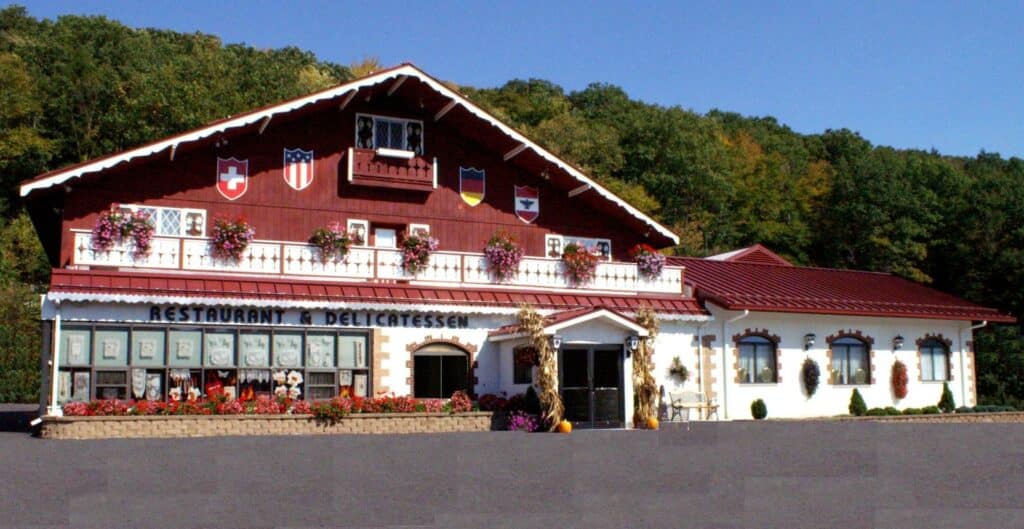
For much of its history, Alpine served food like this in-house. The business once operated a roughly 140-seat German restaurant alongside its butcher and deli operations, drawing locals and visitors alike for traditional plates rooted in old-country technique. When COVID disrupted tourism and staffing, the restaurant closed. Efforts to reopen stalled. Eventually, the dining room was repurposed, and the business refocused its energy where it had always been strongest.
What remained, and what still defines Alpine, is production. The shop operates three on-site smokehouses and functions first and foremost as a butcher, smokehouse, and sausage maker. From fresh cuts and deli meats to wild game processing, the work is steady, repetitive, and exacting. The shift away from a sit-down restaurant wasn’t a reinvention so much as a narrowing of focus.
Seen in that context, the Kale & Pinkelwurst dinner isn’t a novelty or a sentimental callback. It’s an example of how Alpine keeps its cooking traditions alive now: through occasional, deliberate prepared-food offerings that fit its current model. The format has changed. The food hasn’t.
That confidence is backed by craft. Alpine has earned multiple medals at the DFV-AAMP Quality Competition for Sausage and Ham, an international contest judged against European standards. Gold medals for Bauernwurst and all-beef skinless frankfurters. Additional recognition for liver spread and natural casing franks. These awards measure fundamentals, texture, aroma, flavor, the quiet markers of food made to sustain rather than perform.
Walk into Alpine today, and you see a business that knows its rhythm. Long glass cases filled with fresh roasts, house-made sausages, and smoked meats. Prepared salads and cold cuts shaped by repetition and consistency. Shelves stocked with imported German pantry goods, cookies, pickles, chocolates, the kinds of things people drive out of their way to buy because there’s no easy substitute.
Within the 570 food scene, Alpine occupies a different lane than most restaurants. It isn’t chasing trends or expanding menus. It’s a destination built on trust, a place people return to because they know what they’re getting and why it works. When Alpine offers a prepared dinner, it carries the weight of that expectation.
For two days at the end of January, Grünkohl mit Pinkel returns not as a throwback, but as a practical response to winter. A dish designed for cold weather, made by people who understand both the food and the season it belongs to. In a region that values tradition when it’s earned, that feels less like an announcement and more like an invitation: to eat well, and eat warmly, while winter still has something to say.